“The things you own end up owning you.”
— Tyler Durden (Fight Club)
The Prison of Ownership
Imagine you’ve finally found it.
The perfect place. A piece of land that feels like home. You stretch your budget to buy it ,expensive, but doable. There’s no money left for a house, so you turn to a tiny home instead. It seems like a smart, free choice.
But land asks for care. Preparing the ground, tending a garden, maintaining what you’ve built. Slowly, almost unnoticed, freedom begins to shift into responsibility. As a remote worker and traveler, you realize something essential: you can move online, but your land cannot move with you.

For many nomads, that is exactly the dilemma. Buying land feels like losing freedom, while a tiny house promises mobility, a home that can travel with you. Yet a tiny house still needs a place to stand. And so the circle closes. Whether you buy land first or a tiny house first, you end up facing the same question: how do you balance freedom of movement with responsibility for place, without turning ownership into a cage?
One possible response is not to look for a different form of ownership, but to reduce the weight of what is owned in the first place.
Why Less Is More
Choosing less space often brings more clarity. A tiny house reduces not only square meters, but also decisions, maintenance, and mental noise. Fewer possessions ask for more intention. What you keep, you use. What you build, you care for. In that sense, “less” is not about deprivation, but about alignment, between how you live, how you move, and what truly supports your daily life. For many nomads, this is where the appeal lies: not in owning less for its own sake, but in carrying only what allows life to stay flexible, responsive, and light.

But reducing what you carry means trusting that what you don’t own can still be available when you need it. That kind of trust doesn’t exist in isolation. It grows through connection.
Rooted Through Connection
In nature, roots thrive through exchange. They release what they don’t need into the soil and absorb what supports their growth in return. This quiet collaboration creates resilience, not through possession, but through ongoing relationship. Applied to how we live, being rooted no longer means holding onto a place, but participating in a system of mutual care.
Connection becomes a form of grounding: knowing that what you need is not stored in what you own, but in the relationships that hold a place alive, and that someone is there to take care of it, even when you are not.

Invest in Relations Instead of Ownership
In theory, investing in relations instead of ownership seems like a logical step. In practice, it’s difficult. We’ve learned to value almost every interaction in terms of money, and as a result, we’ve lost a shared way to recognize care. Relations grow through attention, commitment, and showing up, not through contracts alone. When this kind of investment isn’t visible or valued, trust erodes and community remains fragile. Without a way to acknowledge relational investment as real value, sharing land or a home stays an unresolved challenge.
The Turning Point
We are at a turning point. The systems we built to organize value and security have slowly disconnected us, from each other, from place, and from natural cycles of exchange. Trust was outsourced to structures, and relationships became transactional.
Nature works differently. It creates ecosystems where balance and continuity emerge through connection, not control. The challenge we face now is not to return to the past, but to restore connection, and to relearn how to trust relationships again.

The Role of AI in Reconnecting Us
AI can support this shift, not by replacing trust, but by making contribution and care visible again. Until recently, the shared patterns of time, space, and responsibility were simply too complex to grasp. Today, AI makes it possible to recognize how value flows through living systems: who contributes, when, and in what way. This creates room for tools that go beyond ownership, and instead acknowledge participation, shared use of space, and time invested, turning connection into something we can see, understand, and work with.
If contribution, time, and shared use of space can be made visible, the question shifts from what do we buy to how do we share.
From Ownership to Tokens
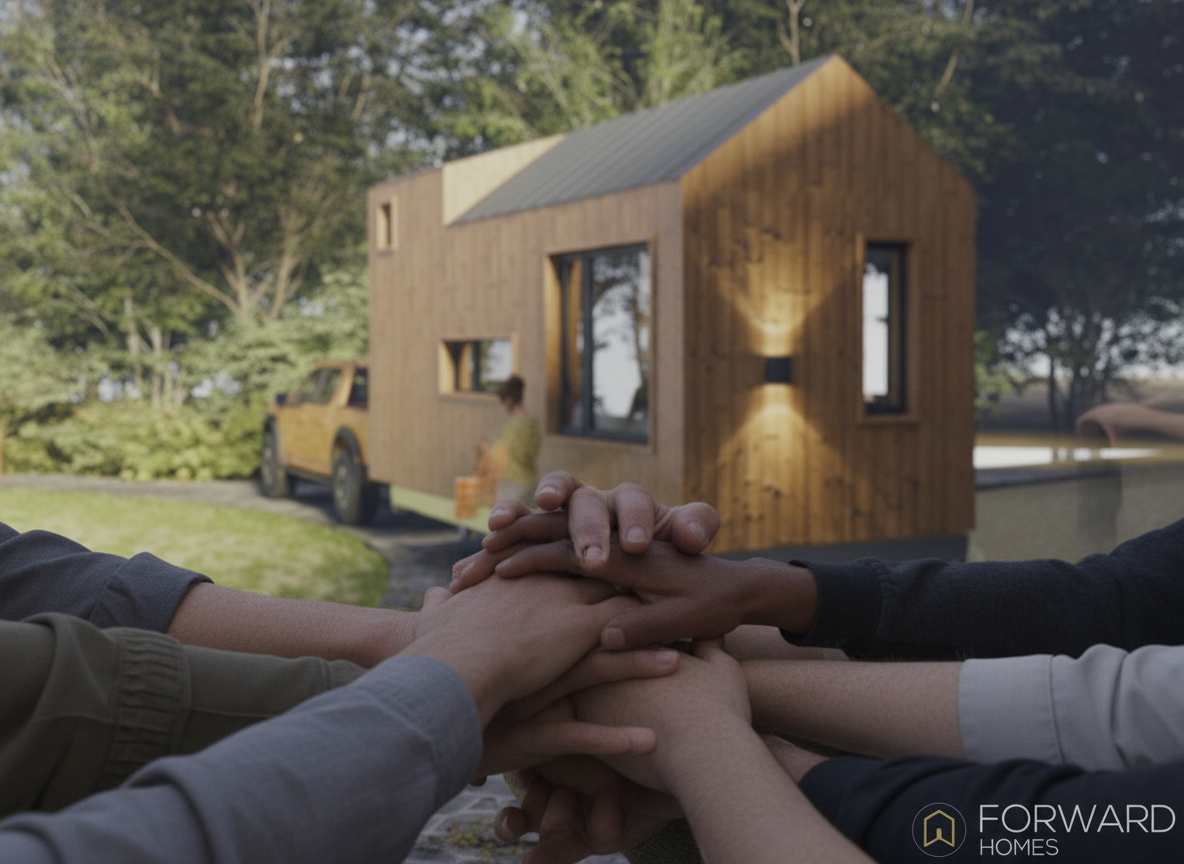
This is where buying a tiny house together begins to make sense. Not as shared property in the traditional sense, but as a shared commitment.
Tokens are not a currency for speculation, but a practical way to recognize participation: time invested, care given, space shared, and responsibility carried. Instead of purchasing permanent ownership, access grows through contribution.

Presence matters, but absence doesn’t break the bond. In this way, a tiny house becomes more than a structure on land, it becomes a living agreement, shaped by time, trust, and shared care.
Join the Exploration
My Experience is a movement exploring regenerative ways of living and traveling, rooted in freedom, connection, and respect for place. We’re currently working on a real-life case study: buying a tiny house together on a finca in Gran Canaria, using life tokens to value time, contribution, and shared care.
If this resonates with you, you’re welcome to join My Experience, follow the process, or take part in the conversation. And if you want to explore these ideas in person, come to the Gran Canaria Nomad Fest – Pilot Edition 2026 to learn, share, and co-create what comes next.


You’re welcome Yineke! Here’s hoping you have a wonderful week! xox